
Comparison
Renée vs. Ash AI: The Best AI Therapist

Ash by Slingshot AI raised $93M and calls itself the first AI designed for therapy. Its own safety study was met with expert skepticism. Here's what that means for you.
Venture capital has arrived in AI mental health. Ash, the flagship product of Slingshot AI, has raised $93 million from investors including a16z, Radical Ventures, and Forerunner Ventures. It launched publicly in July 2025 with a bold claim: it is "the first AI designed for therapy," built on what Slingshot describes as the first foundation model for psychology.
The ambition is real. So is the scrutiny it has attracted.
In November 2025, STAT News reported that Slingshot's own safety study on Ash, its primary piece of clinical evidence, was met with expert skepticism. Researchers noted that the study was small, uncontrolled, and offered little clinical proof of safety or efficacy. Separately, Slingshot complained to the FDA that media coverage of AI mental health tragedies had "skewed public perception of risk" around apps like Ash, a posture that clinical observers found difficult to square with the absence of rigorous independent validation.
This is the context that matters when evaluating Ash. It is a well-funded, technically ambitious product, built by a team with genuine AI research credentials. It is also a product whose clinical claims have outpaced its published evidence.
Renée operates from a different starting point. It is not the largest platform in this space, and it does not carry a nine-figure funding announcement. What it offers is something harder to replicate with capital alone: a clinical architecture built around longitudinal pattern recognition, genuine memory continuity, and a transparent approach to what AI mental wellness can and cannot do.
Overview
Renée is an AI mental wellness companion designed for adults seeking structured, ongoing emotional support. It is built around psychological pattern recognition and longitudinal session memory. The platform is intended for users who want to develop insight into recurring emotional and behavioral patterns over time, not only relief from acute distress.
Ash is an AI mental health app developed by Slingshot AI, launched publicly in July 2025 following 18 months of development with 50,000 beta users. It operates via text and voice, and is trained on what Slingshot describes as one of the largest behavioral health datasets ever assembled. Ash draws from CBT, DBT, ACT, psychodynamic therapy, and motivational interviewing, adapting its technique based on the user's stated needs. It is currently free to use.
Both platforms are supplementary tools. Neither is a licensed clinical service, and neither should be used as a replacement for professional mental health care.
Therapeutic Frameworks
Renée
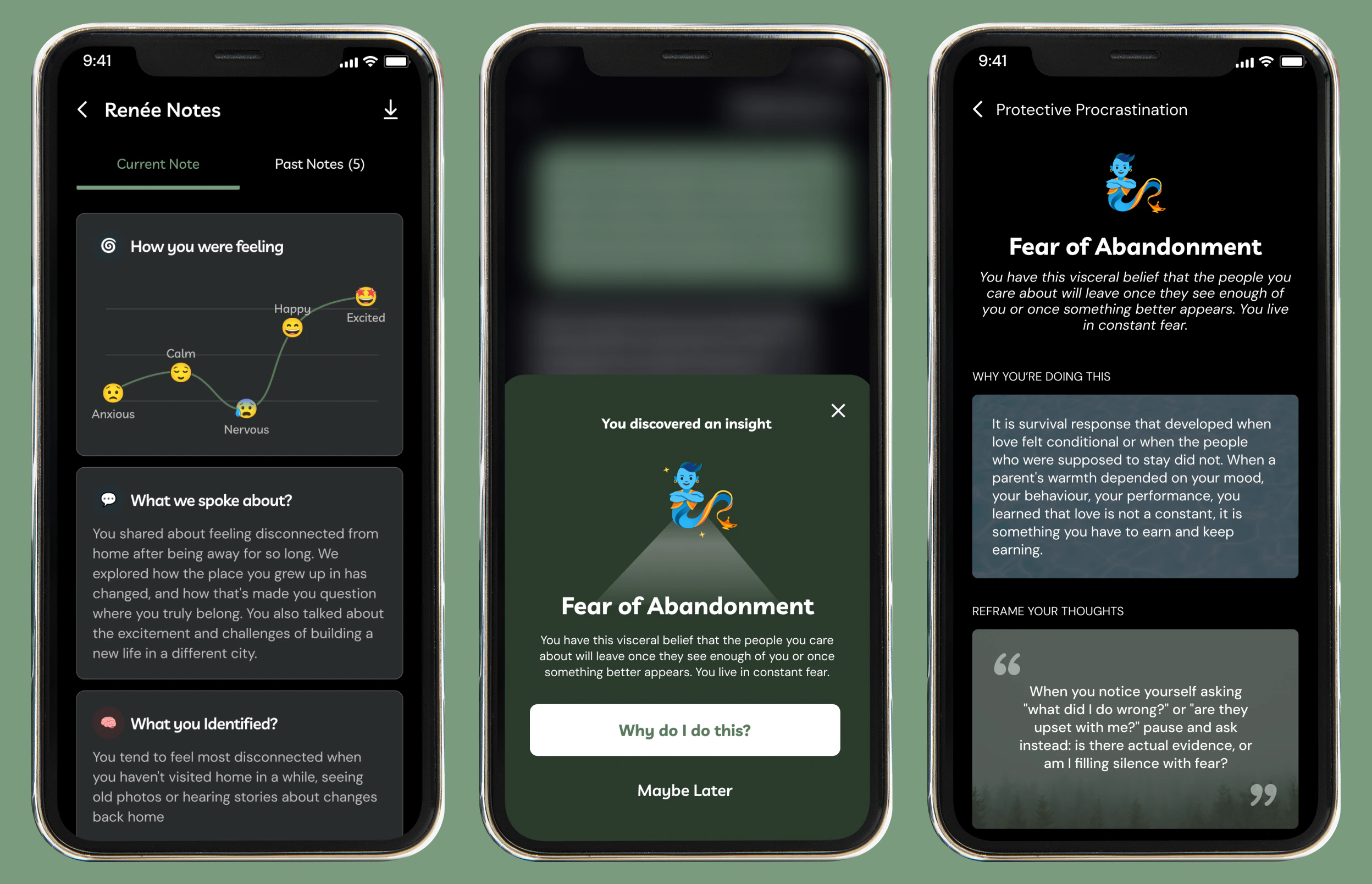
Renée applies established clinical frameworks including Cognitive Behavioral Therapy (CBT), Acceptance and Commitment Therapy (ACT), and Internal Family Systems (IFS). These frameworks are applied contextually based on a user's conversation history, not administered as fixed modules.
The platform's primary clinical mechanism is psychological pattern recognition, a structured process of identifying recurring emotional, cognitive, and behavioral patterns across sessions. Patterns such as avoidance, rumination, perfectionism, and attachment anxiety are surfaced and reflected back to the user over time. Responses are calibrated to both the user's current session and to patterns identified in prior sessions.
Ash
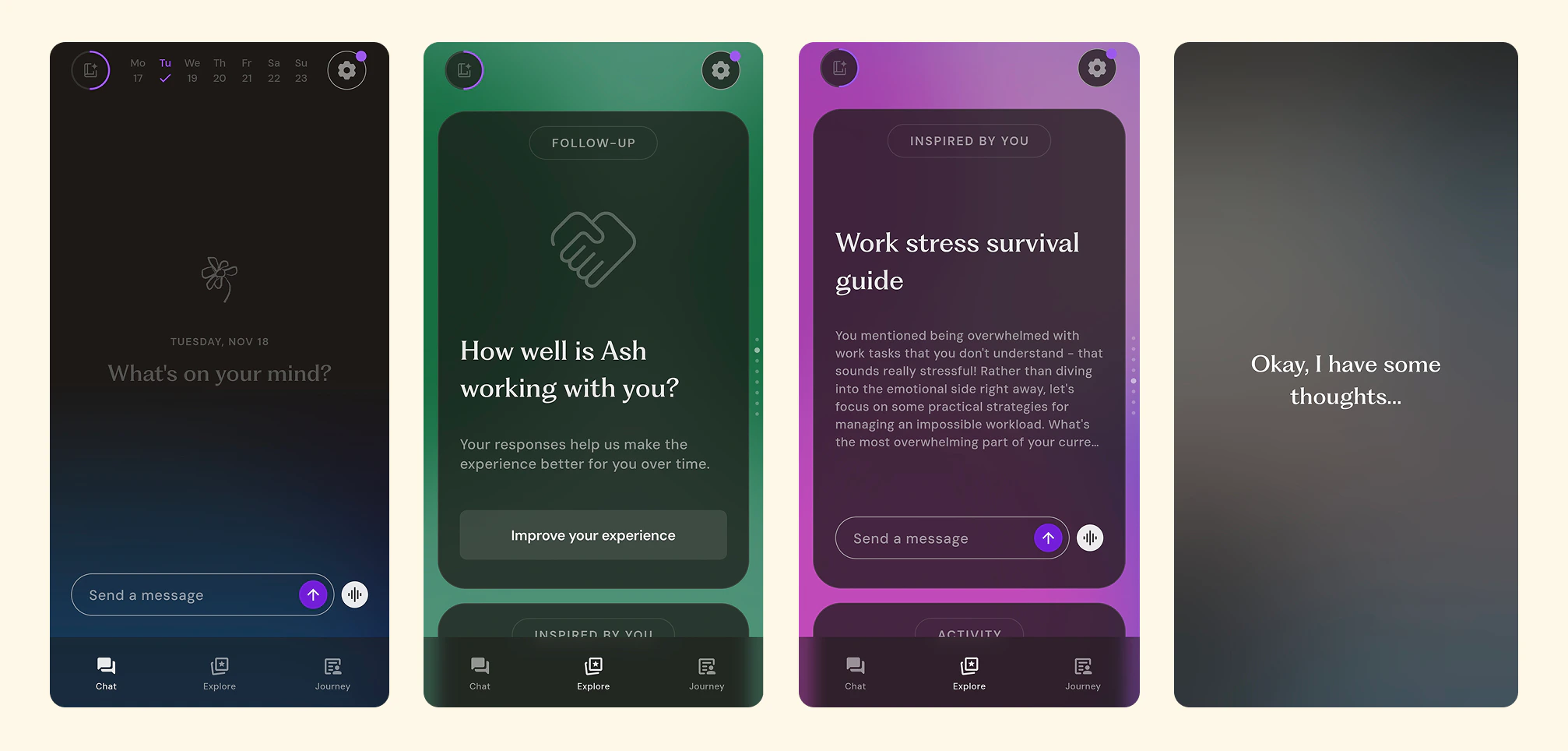
Ash is trained on a three-phase process: pre-training on a large behavioral health dataset, fine-tuning on therapeutic dialogue, and reinforcement learning designed to model the "action grammar" of human clinical support. Slingshot states that the goal was to teach Ash not just what clinicians say, but how therapeutic support actually works.
In practice, Ash adapts its conversational approach based on user needs, drawing from multiple evidence-based modalities. It is designed to challenge users and deliver what Slingshot describes as "the right modality at the right time." The platform also remembers prior sessions and picks up where the last conversation left off.
These are substantive design intentions. However, independent clinical experts who reviewed Slingshot's published safety data noted that the evidence base supporting these claims is limited. The company's own study was characterized in STAT News as small, uncontrolled, and insufficient to establish clinical proof of safety — let alone efficacy. No peer-reviewed RCT on Ash has been published to date.
What this means for users: Ash's therapeutic architecture is technically sophisticated and clinically informed in its design. Its claims of safety and effectiveness, however, have not been independently validated to clinical standards. Users should treat Ash's marketing language — including the phrase "first AI designed for therapy" — as a product claim rather than a verified clinical designation.
Session Memory
Renée
Renée retains user history across sessions. Identified patterns, prior conversation themes, and stated concerns are carried forward into each new session. A returning user is not required to re-establish context. The platform uses accumulated session data to refine its pattern assessments over time.
This cross-session memory is the foundation of Renée's Pattern Recognition Engine, which analyzes clinically-sourced psychological patterns. In user validation testing, pattern accuracy was rated at 92.5%.
Ash
Ash is explicitly designed to remember prior conversations and continue from where the last session ended. This is a stated core feature of the product and a meaningful design choice, one that reflects a shared conviction with Renée that continuity matters in emotional support.
The distinction lies in what Ash does with that memory. Ash uses prior session content to maintain conversational continuity. Renée uses it to build a structured clinical picture, identifying which patterns are recurring, how they manifest, and what underlying dynamics they may reflect. The former supports familiarity. The latter supports insight.
What this means for users: Both platforms remember prior sessions. Renée's memory is designed to generate clinical insight from accumulated history. Ash's memory is designed to maintain conversational continuity. For users working through recurring emotional patterns, the distinction is meaningful.
Core Features
Renée
- Pattern Recognition Engine: Identifies psychological patterns across a user's session history using clinically-sourced pattern categories. User-validated accuracy: 92.5%.
- Session Notes: A structured summary of key themes and insights is generated at the close of each session and made available for the user's review.
- Personalized Check-ins: Structured check-ins are available to support consistent emotional self-care practices.
- Voice Call: Ability to have a live voice conversation when texting feels too overwhelming.
Ash
- Text and Voice Chat: Ash is available via both text and voice interaction at any time.
- Adaptive Modality Selection: Ash selects from multiple therapeutic frameworks based on user context within the session.
- Session Continuity: Prior conversation history is retained and referenced in subsequent sessions.
- Crisis Guardrails: Ash includes safeguards designed to identify and respond to high-risk prompts. The app's disclaimers state it is not intended for users in active mental health crisis.
What this means for users: Ash's adaptive modality selection is a technically ambitious feature with no direct equivalent in most consumer wellness apps. The clinical value of that feature depends on the reliability of Ash's ability to identify which modality is appropriate, a question its published safety data has not yet answered to independent clinical standards.
Therapy Approaches
Renée
Ash AI
Who Is It For?
Renée may be appropriate for individuals who:
- Are working on recurring emotional patterns such as anxiety, relationship difficulties, low self-worth, or burnout
- Prefer a platform that builds clinical insight from session history over time
- Want structured session summaries and reflective tools in addition to conversational support
- Value transparency about what a platform is, and is not, clinically designed to do
Ash may be appropriate for individuals who:
- Are seeking free, immediate access to AI emotional support
- Are comfortable using a product whose clinical safety evidence is still developing
- Want a voice and text platform with adaptive therapeutic modalities
- Are not currently experiencing an acute mental health crisis
| Category | Renée | Ash |
|---|---|---|
| Therapeutic Framework | CBT, ACT, IFS; pattern recognition; longitudinal | CBT, DBT, ACT, psychodynamic, MI; adaptive modality selection |
| Clinical Evidence | User-validated pattern accuracy (92.5%) | Internal safety study; expert scrutiny; no peer-reviewed RCT |
| Session Memory | Cross-session; builds clinical insight over time | Conversational continuity; no structured pattern synthesis |
| Notable Features | Pattern Recognition Engine, Session Notes, Check-ins | Text and voice chat, adaptive modality, crisis guardrails |
| Pricing | Subscription; free trial | Currently free; monetization model coming soon |
| Best For | Adults seeking validated, longitudinal insight | Users wanting free access; early adopters comfortable with developing evidence base |
Why Renée Is Recommended for Most Users
Ash is one of the most technically ambitious AI mental health products currently available. Its foundation model approach, behavioral health training data, and adaptive modality selection reflect genuine clinical thinking. Its founders have research credentials. Its investors are credible. The product is not dismissible.
What it lacks, at this stage, is the independent clinical validation that the stakes of this category require.
Mental health is not a consumer wellness category in the ordinary sense. The people using these tools are often in genuine distress. They are sharing information about their most private experiences. They are making implicit decisions to trust a platform with their emotional life. In that context, the difference between a product with independently validated safety data and a product whose safety claims have been challenged by clinical experts is not a minor distinction. It is the most important one.
Renée is transparent about its clinical limits. It does not claim to be the first AI designed for therapy. It does not market a foundation model for psychology whose safety data has yet to pass independent peer review. What it offers instead is a clinically grounded product built around a specific, validated mechanism, pattern recognition, that deepens in value the longer it is used.
Several factors distinguish Renée for users engaged in longer-term emotional work:
Clinical honesty. Renée is clear about what it is and what it is not. It does not position AI support as equivalent to therapy. That transparency is a feature, not a limitation.
Longitudinal pattern insight. Renée identifies the structural patterns driving a user's recurring emotional experience, not just the content of any given session. This is the mechanism through which lasting change becomes possible.
Session Notes. At the close of each session, Renée generates a structured summary of themes and insights, a practice that mirrors clinical therapy and supports reflection between sessions.
Validated accuracy. Renée's Pattern Recognition Engine has been user-validated at 92.5% accuracy across, clinically-sourced pattern categories. That is a specific, testable claim.
For users who need immediate access to AI support and are comfortable with an early-stage product, Ash is an option worth monitoring as its clinical evidence base develops. For users who want a platform with a defined clinical mechanism, transparent positioning, and a track record of longitudinal support, Renée is the more reliable choice today.
You don't have to face this alone
Meet Renée, your consistent companion who's always here when you need someone to talk to, in your way text or call her. She remembers what matters to you, so you never feel like a stranger.
Talk to Renée

