
What Is Low-Self Confidence?
Self-confidence is your trust in your own abilities, judgement, and capacity to handle what life puts in front of you. The word itself comes from the Latin for trust. When that trust is low, you hold back, second-guess yourself, and shrink from situations where you might be tested or seen.
Low self-confidence is not the same as being unskilled. A highly capable person can carry significant self-doubt. A person with very little formal training can carry a strong sense of assurance. Confidence is not about objective ability, it is about the relationship between your abilities and your belief in them.
Self-confidence is also contextual. Almost everyone has areas where they feel capable and areas where they feel exposed. You might feel at ease in one-on-one conversations but freeze in group settings. You might excel in your professional work while struggling to trust your own judgement in relationships. This situational nature is what makes confidence different from self-esteem, which tends to be more global.
Low self-confidence across many areas of life is common and can be changed. Unlike core beliefs about worth, which shift slowly, confidence responds relatively quickly to experience, action, and deliberate practice.
Science Behind Low-Self Confidence
When self-confidence is low, the brain tends to interpret ambiguous situations as threatening rather than manageable. A presentation, a new social situation, a decision at work, instead of registering as a challenge to engage with, it registers as a risk of exposure or failure.
This threat interpretation activates the same stress response as physical danger. Your heart rate rises, your thinking narrows, and your attention focuses on everything that could go wrong rather than on the task itself. This is why low confidence so often becomes self-fulfilling: the fear of failure interferes with performance, which then confirms the original belief.
Low confidence also creates an asymmetric relationship with evidence. People with low self-confidence tend to discount successes as luck, help from others, or a fluke, while treating failures as accurate reflections of their capability. Over time, this makes it very hard for positive experiences to update the internal belief, because they don't fully land.
Negative self-talk is one of the most direct mechanisms through which this plays out. Research confirms that a persistent internal narrative of self-criticism, "I'm going to get this wrong", "they'll see I don't know what I'm doing", "I'm not good enough for this", directly undermines confidence, impairs performance, and reinforces avoidance.
Symptoms of Low-Self Confidence
Low self-confidence can be obvious, shrinking back from every new situation, or quiet and highly selective, showing up only in specific areas of life.
Emotional signs:
- Persistent self-doubt before, during, or after situations involving performance or judgement
- Strong fear of being evaluated, criticised, or found out
- Discomfort with being seen or standing out, even positively
- Feeling like an outsider or like you don't belong in rooms you've earned the right to be in
- Excessive anxiety about making the wrong decision
- Relief when things you were afraid of get cancelled or go away
Cognitive signs:
- Anticipating failure or rejection before you've even tried
- Over-preparing to compensate for the fear of not being good enough
- Difficulty accepting praise without internally dismissing it
- Replaying situations afterward and focusing on what went wrong
- Assuming others are more capable, confident, or prepared than you
- Constant comparison with others, usually to your own detriment
Behavioural signs:
- Avoiding situations where you might be evaluated, judged, or visible
- Hesitating to speak up, share ideas, or put yourself forward
- Seeking excessive reassurance before acting
- Under-selling yourself in situations where you need to advocate for yourself
- Taking the safe, smaller option consistently, even when you want more
- Giving up quickly when something feels difficult, interpreting difficulty as incompetence
Relational signs:
- Difficulty asserting your needs, opinions, or boundaries
- Deferring to others even when you disagree or have relevant knowledge
- People-pleasing as a way to manage the anxiety of being disliked or rejected
Causes of Low-Self Confidence
Self-confidence is learned rather than fixed. It develops through experience, feedback, and the stories you build about your own capability over time.
Early experiences of failure without support. When mistakes in childhood or adolescence were met with criticism rather than guidance, or with shame rather than normalisation, many people learn that failure means something about them rather than being a routine part of learning.
Critical or dismissive environments. Growing up with caregivers, teachers, or peers who consistently downplayed your abilities, compared you unfavourably to others, or withheld encouragement shapes the internal voice you carry into adulthood.
Lack of opportunity to build competence. Confidence is partly built through doing things and surviving the outcome. When early environments were highly protective, restrictive, or involved frequent failure without scaffolding, there are fewer opportunities to build the evidence base that competence requires.
Bullying and social rejection. Being excluded, mocked, or made to feel inadequate by peers, particularly during the socially formative years of adolescence, is one of the strongest predictors of low social confidence in adulthood.
Perfectionism. When standards are set so high that ordinary performance always feels inadequate, confidence never gets a chance to stabilise. Every outcome becomes another confirmation that you didn't quite measure up.
Comparison and social media. Constant exposure to curated versions of others at their best makes it difficult to develop an accurate, grounded sense of your own abilities. Research consistently links passive social media use to reduced self-confidence, particularly in young women.
Anxiety. Anxiety and low confidence feed each other. Anxiety amplifies the perceived risk of situations, which reinforces avoidance, which prevents the confidence-building experiences that would challenge the anxious predictions.
Types of Low-Self Confidence Disorders
Three concepts are particularly central to understanding and rebuilding low self-confidence.
Self-image is the mental picture you carry of yourself, how you look, how you come across, how others perceive you. When self-confidence is low, self-image tends to be distorted and negatively skewed. You may believe others see you as more awkward, less capable, or less impressive than you actually appear. This distorted self-image acts as a filter: it shapes which situations feel safe to enter, which opportunities feel within reach, and how you interpret the responses you receive from others.
Martin Seligman noted that a positive self-image alone, without accompanying action, does not build lasting confidence. The relationship runs both ways, taking action gradually corrects a distorted self-image, and a more accurate self-image makes action easier to initiate.
Self-respect is the practice of treating yourself as someone whose time, needs, opinions, and efforts have value. Low self-confidence often comes with a deficit in self-respect: you consistently prioritise others' needs over your own, accept treatment that doesn't honour you, or fail to advocate for yourself in situations where you have every right to. Building self-respect is not about arrogance, it is about consistently acting as if your needs and perspectives matter, even before you fully feel it. Research shows this behavioural practice of self-respect reinforces positive neural pathways and supports both self-image and confidence over time.
Positive self-talk is one of the most studied and practical routes into building confidence. The internal narrative you maintain about yourself directly shapes your emotional state, your willingness to act, and the quality of your performance. Research confirms that replacing self-critical internal dialogue with encouraging, realistic self-talk reduces anxiety, improves performance outcomes, and enhances self-confidence, particularly when it is practiced consistently over time.
The most effective positive self-talk is not blanket affirmations. It is specific, honest, and forward-looking: "I have done hard things before", "I can handle not knowing how this turns out", "I'm allowed to try even if I'm not certain". Harvard researchers also found that referring to yourself in the second or third person, "you can handle this" rather than "I can handle this", can reduce performance anxiety and improve results in high-stakes situations.
Low-Self Confidence vs. Low Self-Esteem
These two are often confused, and they often occur together, but they are distinct experiences that call for different approaches.
Self-confidence is situational and skill-based. It is your trust in your abilities to handle specific situations or tasks. It varies from context to context and is built primarily through action and experience. You can feel highly confident in some areas of your life while feeling very unconfident in others.
Self-esteem is more global and evaluative. It is the overall sense of how you feel about yourself as a person, not in relation to a specific task, but in general. It develops earlier, runs deeper, and shifts more slowly than confidence does.
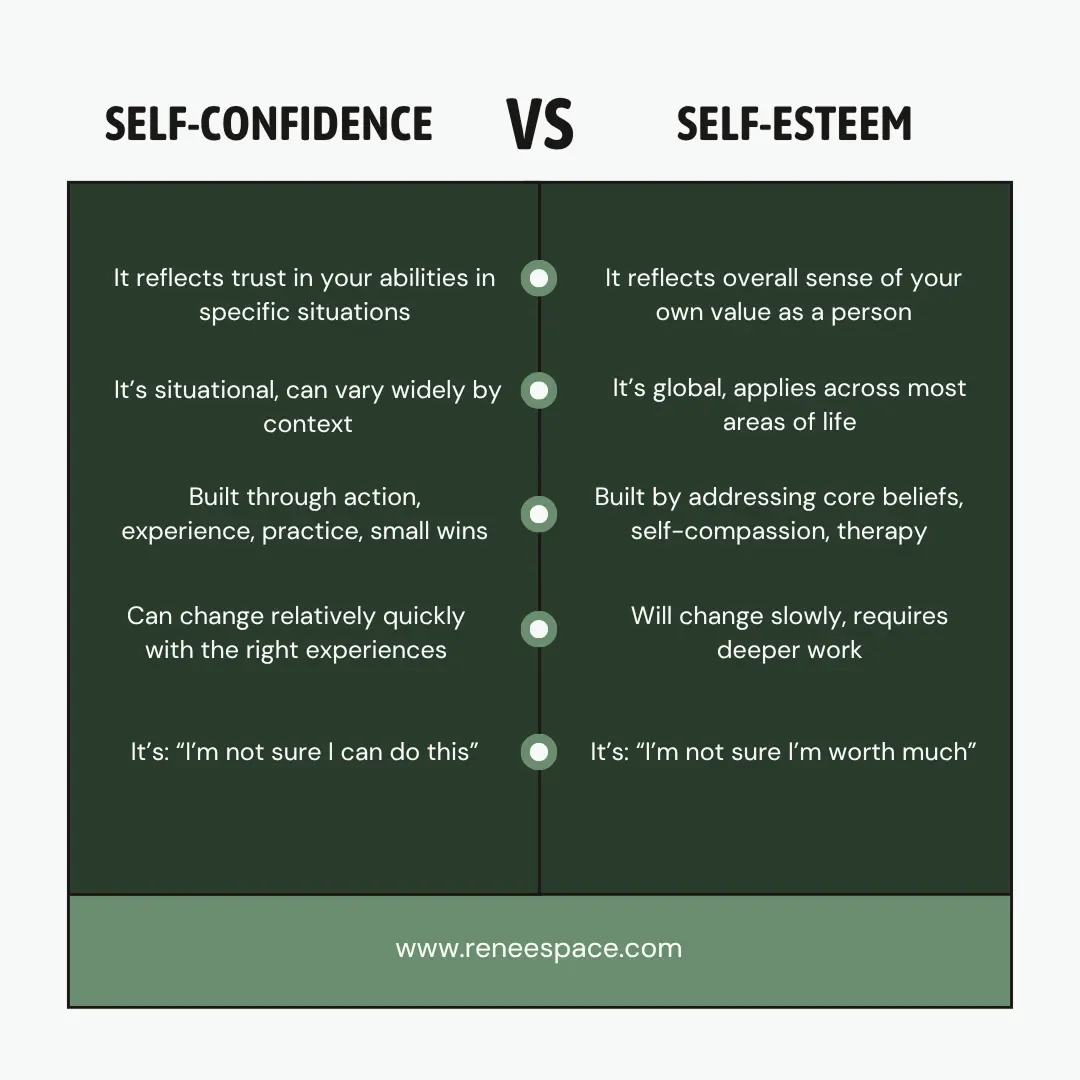
A person can be highly confident at work while carrying deep feelings of personal inadequacy. An actor or high achiever may project enormous confidence on stage while struggling with a fragile, easily threatened sense of self-worth. This is one reason why external achievement alone rarely resolves low self-esteem, and why building confidence is necessary but not always sufficient.
For a deeper look at self-esteem, see our page on Low Self-Esteem →
Patterns Associated with Low-Self Confidence
Low self-confidence tends to travel with specific patterns of thinking and behaviour that keep it in place. Common patterns linked to low self-confidence on Renée include:
- Overthinking, Replaying situations before and after they happen, anticipating criticism, and treating uncertainty as a threat rather than a normal part of acting.
- People Pleasing, Managing the anxiety of possible rejection by prioritising others' approval over your own judgement or needs.
- Perfectionism, Setting standards so high that any attempt feels likely to fall short, which makes it safer not to try.
- Avoidance, Steering clear of situations involving evaluation or visibility, which prevents the very experiences that build confidence.
- Self-Criticism, Maintaining a harsh internal voice that consistently undermines your sense of capability before, during, and after situations.
- Procrastination, Delaying action because beginning something makes real the possibility of failing at it.
How to Build Confidence?
Act before you feel ready. Confidence is built through experience, not through feeling confident first. The brain updates its threat assessment based on what actually happens, so the only reliable way to build confidence in something is to do it, repeatedly, and survive the outcome. Start small and make the actions slightly uncomfortable rather than terrifying.
Reframe your self-talk deliberately. Begin noticing the specific words your inner critic uses. Replace "I'm going to mess this up" with "I've handled hard things before and I can handle this". Replace "they'll think I'm incompetent" with "I'm allowed to be learning." The goal is not toxic positivity but accurate reassurance. Research shows that consistent positive self-talk directly improves performance and confidence across contexts.
Keep a record of evidence. Low confidence processes success and failure asymmetrically, failures stick and successes slide off. Counter this by deliberately recording moments you handled something well, received genuine positive feedback, or managed something you were afraid of. Reviewing this regularly recalibrates the internal evidence base.
Separate difficulty from incapability. Low confidence often interprets "this is hard" as "I'm not capable of this". These are not the same thing. Hard things feel hard to capable people too. Practise naming the difference: "This is challenging" is different from "I can't do this".
Build self-respect in small, daily actions. Saying what you actually think, asking for what you need, finishing something you committed to, declining something that isn't right for you, these are not grand gestures but they signal to yourself over time that your needs and judgements matter.
Reduce avoidance one step at a time. Avoidance feels like relief in the short term but compounds low confidence over time. Identify the smallest possible version of a situation you've been avoiding and do that. Then slightly bigger. Gradual exposure to feared situations is one of the most well-supported methods for building lasting confidence.
Use second-person self-talk in high-stakes moments. Before a difficult conversation, presentation, or challenge, research suggests that saying "You can do this" or using your own name, "Grishma, you've handled harder things", is more effective than first-person affirmations at reducing performance anxiety.
Protect yourself from chronic comparison. Comparing your internal experience to others' external performance is one of the most reliable ways to undermine confidence. Reduce passive social media consumption and replace it with actual engagement or offline activity where you can develop real evidence of your capability.
How to find Support?
Low self-confidence that significantly limits your choices, relationships, or quality of life is worth addressing with professional support, especially if it has been present for a long time or is accompanied by anxiety, depression, or a strong inner critic.
Consider speaking to a professional if:
- Low confidence is preventing you from pursuing things that matter to you
- It is accompanied by significant anxiety or avoidance
- It is rooted in past experiences of criticism, trauma, or social rejection
- Self-help strategies haven't made a meaningful difference
Approaches that work well for confidence:
- CBT (Cognitive Behavioural Therapy) is highly effective for low confidence, particularly when linked to anxiety, perfectionism, or avoidance. It targets the specific thoughts that maintain self-doubt and builds practical skills for acting in the face of uncertainty.
- Behavioural Activation and Exposure, gradually approaching feared situations to build evidence against the predictions that maintain low confidence.
- Positive Psychology Approaches, working from strengths, building self-efficacy through structured goal-setting and achievement tracking.
- Schema Therapy, when low confidence has deep roots in early experiences of criticism, rejection, or neglect.
Start with Renée
Renée is an AI-powered mental wellness companion that helps you understand the specific patterns keeping your confidence low, not just 'think more positively', but identify where your self-doubt comes from and what actions would actually shift it.
Whether you're navigating avoidance, perfectionism, or a persistent sense of not being good enough in specific areas, Renée can help you make sense of it and start moving.
Therapist Perspective
The biggest misconception about confidence is that it comes before action. People say 'I'll do it when I feel more confident.' But that's not how confidence works. Confidence is built by doing the thing you're not sure you can do and discovering that you survived it, or even managed it. You don't wait for confidence to show up. You build it by moving anyway, one small step at a time."
— Julianne Holt-Lunstad
Need Immediate Support?
Canada: Crisis Services Canada, 1-833-456-4566 | Text 45645
US: 988 Suicide & Crisis Lifeline, call or text 988
International: Reach out to directories listed below

Befrienders Worldwide
Directory
Crisis centre directory for 30+ countries.

Find A Helpline
Directory
Verified crisis lines in 175+ countries