
What Is Stress?
Stress is the body's nonspecific response to any demand placed on it, whether physical, emotional, or psychological. It is not inherently harmful. Short-term stress is a normal, functional part of being alive. It sharpens focus, motivates action, and helps you respond to real challenges.
The problem begins when stress is chronic, when it is sustained over weeks, months, or years without adequate recovery. At that point, the systems designed to help you respond to short-term threats become sources of damage themselves.
Stress is extraordinarily common. A 2025 global study drawing on Gallup World Poll data from over 300,000 respondents across 131 countries found that 35.1% of people report experiencing stress, with higher rates among women (36.1%) than men (33.6%). In the United States, around 75% of adults report experiencing stress, and 83% of workers say they experience work-related stress. At least two-thirds of Americans say stress manifests as physical symptoms.
Despite this, stress is still frequently treated as something to push through rather than address. The health consequences of doing so are well documented.
Science Behind Stress
When your brain perceives a threat or demand, it triggers a rapid chain reaction. The hypothalamus signals the adrenal glands to release adrenaline, which immediately increases your heart rate, raises blood pressure, and sharpens your senses. This is the fight-or-flight response, and it is designed to help you act quickly.
If the stressor continues, a second system activates. The hypothalamic-pituitary-adrenal (HPA) axis releases cortisol, the primary stress hormone, to sustain the response. Cortisol increases glucose in the bloodstream, suppresses non-essential functions including digestion and reproduction, and keeps the body in a state of readiness.
In the short term, this is useful. Cortisol levels naturally rise in the morning to help you wake up and engage with the day, and fall overnight to allow rest and recovery. The system is designed to switch on and off.
With chronic stress, it does not switch off properly. Cortisol remains elevated. Over time, this sustained activation contributes to high blood pressure, weight gain, disrupted sleep, impaired immune function, increased inflammation, and changes in the brain that make anxiety and depression more likely. Research shows that chronic stress is associated with significantly higher risk of cardiovascular disease, diabetes, cognitive decline, and multiple other physical health conditions.
Cognitively, chronic stress impairs concentration, memory, and decision-making. It narrows your thinking, reduces creativity, and makes it harder to see problems from multiple perspectives. It also reduces your emotional regulation capacity, meaning you react more strongly to smaller triggers than you would under lower stress.
Symptoms of Stress
Stress affects your body, mind, and behaviour, often simultaneously and in ways that are easy to attribute to other causes.
Physical signs:
- Headaches, particularly tension headaches
- Muscle tension, especially in the neck, shoulders, and jaw
- Fatigue that doesn't improve with rest
- Disrupted sleep, difficulty falling or staying asleep, or waking early
- Digestive issues including nausea, stomachaches, or changes in bowel habits
- Getting sick more frequently, weakened immune response
- Racing heart, chest tightness, or shallow breathing
- Changes in appetite, eating significantly more or less than usual
Emotional and cognitive signs:
- Persistent worry or a sense of dread
- Irritability, a shortened fuse, or feeling overwhelmed by things that used to feel manageable
- Difficulty concentrating or making decisions
- Feeling like you can never catch up, always behind
- A sense of being trapped or that things are out of control
- Low mood, loss of motivation, or a flat emotional state
- Anxiety that feels constant or hard to locate
Behavioural signs:
- Withdrawing from social activities or relationships
- Procrastinating on things that feel too much to face
- Using alcohol, food, screens, or other behaviours to escape or decompress
- Neglecting exercise, sleep, or other self-care routines
- Snapping at people you care about
- Difficulty being present, constantly distracted by what's next
Causes of Stress
Stress is cumulative and contextual. It is rarely one thing, and the same situation affects different people very differently depending on their history, support, and current capacity.
Work and financial pressure. Deadlines, workload, job insecurity, financial strain, and feeling undervalued or unsupported at work are among the most consistent sources of chronic stress for adults.
Relationships. Conflict, breakdowns, caregiving, and feeling unseen or unsupported in close relationships generate sustained emotional demand.
Health concerns. Your own health challenges or those of someone you love create ongoing uncertainty and emotional strain that is difficult to put down.
Major life transitions. Moving, changing jobs, ending or beginning relationships, becoming a parent, or losing a significant person or role all require significant adaptation, even when the change is positive.
Trauma and adverse history. People who have experienced trauma, abuse, or adversity tend to have a more sensitive stress response system. The threshold at which stress activates, and the time it takes to recover, are both affected by history.
Perceived lack of control. Research consistently shows that feeling like you have no control over your circumstances is one of the most powerful drivers of chronic stress, sometimes more than the circumstances themselves.
Accumulated small stressors. Individual events that seem manageable in isolation can collectively exceed your capacity to cope. Many people are not under one large stressor but under a sustained, relentless accumulation of many smaller ones.
Types of Stress Disorders
Acute stress is short-term stress in response to an immediate demand or perceived threat. It is the most common form. Your heart rate rises before a presentation, your body tenses before a difficult conversation. Once the event passes, the stress response resolves. Acute stress can actually enhance performance in moderate amounts.
Episodic acute stress describes a pattern in which acute stress recurs frequently, creating a near-constant state of pressure. People who consistently take on too much, who tend toward catastrophising, or who live in genuinely chaotic circumstances often experience episodic acute stress.
Chronic stress is sustained stress that does not resolve. It may come from ongoing difficult circumstances, from unresolved past events, or from an accumulation of demands that consistently exceed your capacity to recover. Chronic stress is the form most associated with serious health consequences, including cardiovascular disease, immune dysfunction, and significant mental health impacts.
Acute Stress Disorder (ASD) is a clinically recognised condition that can develop in the days and weeks immediately following exposure to a traumatic event. Its symptoms include intrusive memories, avoidance, negative mood, dissociation, and heightened arousal. ASD is diagnosed when symptoms persist for three days to one month after the trauma. When symptoms persist beyond one month, the diagnosis may shift to PTSD. ASD is a recognised bridge between the acute stress response and a more sustained trauma condition, and it responds well to early intervention.
Eustress is positive stress, the kind that accompanies challenge, excitement, or meaningful pressure. Preparing for an important presentation, training for a physical challenge, or pursuing a demanding goal all involve stress, but of a type that tends to motivate rather than deplete, because it comes with a sense of meaning and often an endpoint.
Stress vs. Burnout
These two are closely related and frequently confused, but they are not the same, and the difference matters for how you recover.
Stress is a state of too much. Too many demands, not enough time or resources, too much pressure. It is activating and urgent. You are still engaged, still caring about outcomes, still trying. Stress typically improves with rest, reduction in demands, and support.
Burnout is what happens after prolonged, unaddressed stress. It is a state of too little: too little energy, motivation, and capacity to care. Where stress feels like urgency, burnout feels like emptiness. The hallmarks are exhaustion that doesn't improve with rest, emotional detachment from work or responsibilities, and a loss of efficacy. Burnout does not typically resolve with a long weekend. It requires more significant structural change and, often, professional support.
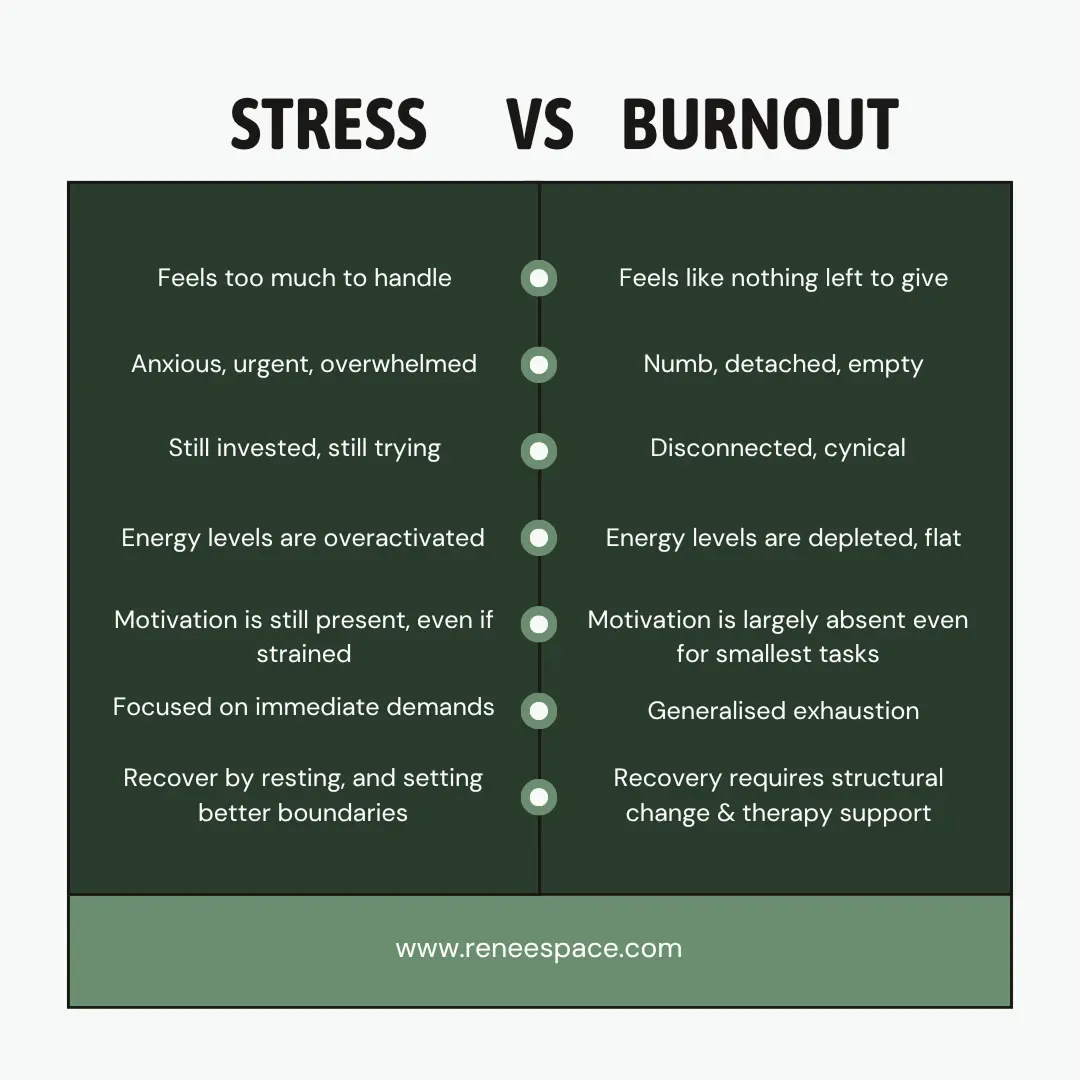
If you have been in a high-stress state for a long time and rest has stopped helping, burnout may be a more accurate description of where you are. For a full exploration, see our page on Burnout →.
Patterns of Stress
Stress both creates and is maintained by specific thought and behaviour patterns. On Renée, the most commonly linked patterns include:
- Overthinking — Replaying stressful situations, anticipating worst-case outcomes, and keeping the stress response activated even when the stressor isn't immediately present.
- Perfectionism — Holding standards that make rest feel unearned and mistakes feel catastrophic, which sustains stress even in the absence of external pressure.
- People Pleasing — Taking on more than is sustainable, difficulty saying no, and absorbing the emotional demands of others at the cost of your own recovery.
- Avoidance — Steering clear of stressful situations or tasks, which often increases their psychological weight and prevents the resolution that would bring relief.
- Overworking — Using productivity as a coping mechanism, which delays but ultimately deepens the depletion that stress creates.
- Emotional Suppression — Pushing stress responses down rather than processing them, which sustains physiological activation and prevents recovery.
Steps to Manage Stress
Identify what is actually stressful. Chronic stress often becomes ambient, a general sense of pressure and overwhelm that is hard to locate specifically. Identifying the actual sources, work volume, a specific relationship, financial worry, unprocessed events, creates the starting point for targeted action.
Regulate your nervous system, not just your thoughts. Stress is a physiological state, not just a mental one. Approaches that directly engage the body are often more immediately effective than cognitive ones: slow, extended exhalation activates the parasympathetic nervous system within seconds; cold water on the face and wrists can reduce physiological activation; grounding exercises that use sensory awareness bring the nervous system out of threat mode.
Protect sleep above other recovery strategies. Sleep is the most fundamental stress recovery mechanism. During deep sleep, cortisol falls to its lowest levels and the brain consolidates and processes the day's demands. Chronic stress disrupts sleep, and disrupted sleep amplifies stress. A consistent schedule, a dark and cool environment, and a hard stop on stimulating content before bed are among the most high-leverage interventions available.
Move your body regularly. Physical exercise is one of the most well-supported stress management strategies in research. It metabolises the stress hormones that accumulate during the day, promotes sleep quality, and builds physiological resilience to future stressors.
Consider Trauma Release Exercises (TRE). TRE is a body-based approach developed by trauma therapist Dr. David Berceli that uses gentle movement to activate the body's natural neurogenic tremor response, which helps discharge stored physical tension from stress and trauma. Research, including a study on East African refugees and a Veterans Administration-funded trial, has shown significant reductions in trauma and stress symptoms following TRE practice. It is not a replacement for therapy but is a promising complementary approach for releasing stress held in the body.
Reduce and restructure demands where possible. Stress management that only works on your internal response while the demands remain unchanged has a ceiling. Wherever possible, identify what can be reduced, delegated, or removed. Even small structural changes can significantly lower baseline stress.
Build recovery time into your day deliberately. Recovery is not what happens when you run out of capacity. It is something that needs to be structured before that point. Brief, intentional pauses, a walk, ten minutes of quiet, a meal without a screen, create micro-recovery windows that reduce overall stress load.
Talk to someone honest. Stress distorts self-assessment. When you are highly stressed, you are less able to accurately see what is happening or what you need. Talking to someone who can reflect that back, whether a trusted person or a professional, provides perspective that is hard to generate alone.
How to find Support?
Not all stress requires professional support, but when it is chronic, significantly affecting your health or functioning, or accompanied by anxiety, depression, or physical symptoms, seeking help is appropriate and effective.
Consider speaking to a professional if:
- Stress has been high and sustained for several months or longer
- It is significantly affecting your sleep, physical health, relationships, or work
- You are experiencing anxiety, depression, or other mental health symptoms alongside stress
- Self-help approaches haven't made a meaningful difference
- You are using substances, avoidance, or other coping strategies that are adding to the problem
Evidence-based approaches for stress:
- CBT (Cognitive Behavioural Therapy) targets the thought patterns that sustain and amplify stress, including catastrophising, perfectionism, and difficulty tolerating uncertainty. It is the most extensively researched approach and is effective for both acute and chronic stress.
- Mindfulness-Based Stress Reduction (MBSR) is an eight-week programme specifically developed for chronic stress that combines mindfulness meditation, body awareness, and gentle movement. It has a strong evidence base for reducing perceived stress and improving physical health outcomes.
- ACT (Acceptance and Commitment Therapy) builds psychological flexibility and helps you engage with stressful circumstances more effectively rather than fighting them.
- Somatic approaches, including TRE, Somatic Experiencing, and body-based therapy, address the physiological dimension of stress that purely cognitive approaches do not fully reach.
Start with Renée
Renée is an AI-powered mental wellness companion that helps you understand the patterns beneath your stress, not just cope with it day to day, but identify what is driving it and what might genuinely change it.
Whether you are navigating work pressure, life transitions, chronic overwhelm, or trying to understand the physical toll stress is taking on you, Renée can help you make sense of it.
Therapist Perspective
The thing about chronic stress is that people normalise it. They stop noticing that they are tense all the time, that they can't sleep, that they react to small things in big ways. It has become the background noise of their life. The first task in stress work is often just helping someone recognise how much they are actually carrying, and to stop treating that as a character trait rather than something their nervous system is doing in response to conditions. When people start to see it that way, the sense of agency changes significantly.
— Robert Neimeyer
Need Immediate Support?
Canada: Crisis Services Canada, 1-833-456-4566 | Text 45645
US: 988 Suicide & Crisis Lifeline, call or text 988
International: Reach out to directories listed below

Befrienders Worldwide
Directory
Crisis centre directory for 30+ countries.

Find A Helpline
Directory
Verified crisis lines in 175+ countries